Data Governance Framework:
Enabling Trusted, Secure, and Compliant Enterprise Data
Syed Kashif Mushtaq
1/28/20262 min read
In today’s data-driven organizations, decisions are only as good as the data behind them—making data governance critical for trust, compliance, and sustainable business growth.
As enterprises increasingly rely on data analytics, business intelligence, and artificial intelligence, unmanaged or inconsistent data becomes a major risk. Common challenges such as conflicting reports, poor data quality, regulatory exposure, and limited trust in analytics are often symptoms of weak or fragmented data governance.
Data governance is the enterprise operating framework that ensures data is trusted, secure, compliant, and aligned with business objectives.
It defines how data is owned, controlled, protected, and used across the organization to support decision-making, analytics, and digital transformation initiatives.
Why Data Governance Is Important for Enterprises
Without a strong data governance framework, organizations frequently face:
Multiple versions of the truth across business units
Low confidence in enterprise reporting and dashboards
Data quality issues affecting financial, operational, and regulatory reporting
Increased security, privacy, and compliance risks
Slow analytics delivery due to manual reconciliation and rework
Effective data governance transforms data from a liability into a trusted enterprise asset.
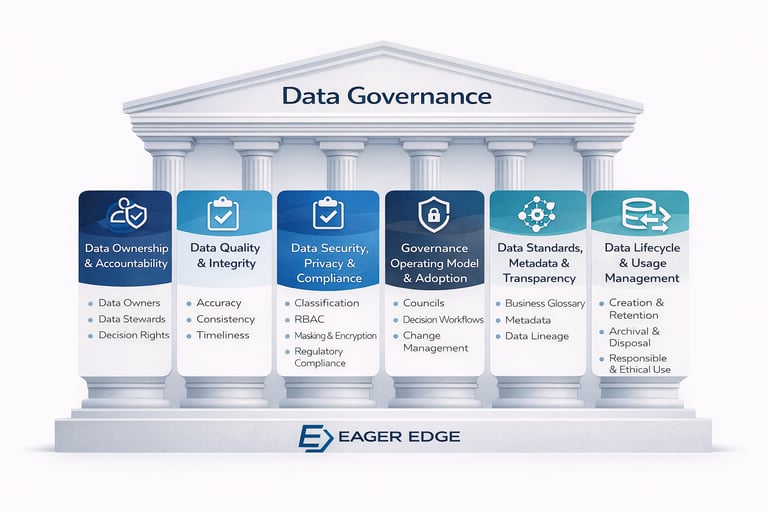
The Six Pillars of Enterprise Data Governance
1. Data Ownership & Accountability
This pillar establishes clear data ownership, stewardship, and decision rights. By defining who owns data and who is accountable for its quality, definitions, and access, organizations eliminate ambiguity and enable faster, more consistent decisions.
2. Data Quality Management & Integrity
Data governance defines what high-quality data means for the business. This includes data quality dimensions such as accuracy, completeness, consistency, and timeliness, supported by measurable rules, thresholds, and issue remediation processes. High data quality is essential for reliable analytics and reporting.
3. Data Security, Privacy & Regulatory Compliance
This pillar focuses on protecting sensitive and regulated data through data classification, role-based access control (RBAC), masking, encryption, and compliance with regulations such as GDPR, SOX, and industry-specific requirements. Governance ensures data is accessible for business use while remaining secure and compliant.
4. Data Governance Operating Model & Adoption
Sustainable data governance requires an operating model. This includes governance councils, decision workflows, escalation paths, change management, training, and communication. Without adoption and enforcement, governance remains theoretical and delivers limited value.
5. Data Standards, Metadata & Transparency
Shared business definitions, metadata management, data catalogs, and lineage create a consistent understanding of data across the enterprise. Transparency improves trust, accelerates onboarding, and enables scalable analytics and self-service reporting.
6. Data Lifecycle & Usage Management
Governs how data is created, retained, shared, reused, and retired across its lifecycle — including responsible analytics and AI usage.
Business Benefits of a Strong Data Governance Strategy
Organizations with mature data governance capabilities consistently achieve:
Trusted, consistent enterprise analytics and dashboards
Reduced regulatory, privacy, and security risk
Faster delivery of data and analytics initiatives
Clear accountability for critical data assets
A scalable foundation for AI, machine learning, and advanced analytics
Conclusion
Data governance is not about restricting data—it is about enabling confident, compliant, and scalable data use.
By establishing clear ownership, quality standards, security controls, and an effective operating model, organizations unlock the full value of their data while minimizing risk.